In modern business, offering a quality product or service is no longer enough on its own to guarantee long-term success. One of the single most crucial competitive advantages is your ability to communicate effortlessly with your clients, respond rapidly to their inquiries, address their needs, and nurture lasting relationships.
With WhatsApp's ubiquitous adoption worldwide, it has become the communication channel of choice for millions of users. Establishing an active, responsive presence via WhatsApp Business is now an essential step for any forward-looking enterprise striving to elevate client satisfaction and optimize operations.
What if you could transform WhatsApp from a simple handheld chat app into an end-to-end automated platform for customer engagement, sales pipeline tracking, and after-sales service?
This is where the transformative capabilities of the WhatsApp Business API come into play.
Why WhatsApp Customer Engagement Has Become Indispensable for Modern Businesses
Today's customers expect immediate, clear answers without enduring long wait times or navigating complex bureaucratic hurdles.
WhatsApp offers an effortless, familiar communication environment, providing companies with an authentic, direct, and flexible channel to connect with their audience.
Key business benefits of leveraging WhatsApp for commercial communication include:
- Blazing-Fast Response Times: Receive customer inquiries and dispatch relevant answers instantly without delay.
- Superior Customer Experience: Provide a direct, comfortable channel that customers already love and use daily.
- Higher Sales Conversion: Nurture interested prospects promptly and convert casual inquiries into confirmed sales orders.
- Long-Term Customer Retention: Maintain seamless post-purchase communication, track customer satisfaction, and foster loyalty.
- Substantial Overhead Savings: Leverage smart automation for repetitive transactional messages, booking reminders, and notifications.
What is the WhatsApp Business API?
The WhatsApp Business API is fundamentally distinct from the consumer WhatsApp Business mobile app.
While the standard mobile app provides basic tools suited for sole proprietors, the WhatsApp Business Platform (API) empowers enterprises to programmatically interface WhatsApp with their core databases, ERP systems, CRM platforms, and custom software architectures.
Through the API, organizations can:
- Trigger automated messaging tied directly to backend system events and database updates.
- Dispatch real-time order confirmations, delivery updates, and tracking links automatically.
- Automate appointment reminders and periodic service maintenance schedules.
- Connect WhatsApp directly with centralized CRM and customer data platforms.
- Ingest incoming customer messages directly into departmental routing queues.
- Develop bespoke integrations with websites, mobile applications, and internal enterprise dashboards.
In doing so, WhatsApp becomes an integral pillar of your company's digital infrastructure, far beyond a disconnected mobile chat application.
Why Integrate the WhatsApp API with Your CRM?
One of the most persistent operational hurdles enterprises face is fragmented customer communication records.
A customer might reach out on WhatsApp, follow up with a telephone call, and later submit an inquiry via web form—leaving their history scattered across different staff devices and email threads, which leads to lost sales opportunities.
Integrating the WhatsApp API directly with your CRM (Customer Relationship Management) system resolves this fragmentation completely.
This synchronization links conversations to centralized customer profiles, coordinates follow-ups, and gives sales and support teams complete 360-degree visibility.
Key strategic advantages include:
1. Unified Customer Communication Logs
Every conversation, timestamp, and query is tied directly to the customer's CRM profile, enabling team members to instantly review historical context and prior requests with total accuracy.
2. Active Sales Pipeline Management
Automatically capture interested leads, monitor communication milestones along the sales pipeline, and assign required next steps to convert leads into closed deals seamlessly.
3. Organized Team Task Routing & Accountability
Distribute incoming customer inquiries across departments and agents according to predefined routing rules, ensuring prompt and specialized handling.
4. Elevated Post-Purchase Care & Support
The relationship does not conclude at checkout. Systematically send satisfaction surveys, warranty information, and periodic maintenance reminders effortlessly.
5. Actionable Analytical Insights
When customer data and response histories are structured centrally, leadership can make confident, data-driven decisions that optimize sales performance and customer delight.
How Automated Messaging Maximizes Efficiency and Saves Time
Daily business operations are full of repetitive tasks: confirming orders, updating tracking numbers, sending booking reminders, and gathering post-service feedback.
Executing these workflows manually drains valuable employee hours and sharply increases the risk of delayed responses or forgotten follow-ups.
With the WhatsApp Business API, you can automate these processes end-to-end, dispatching tailored messages based on predefined events within your management system.
For example:
- When an order is created, the customer receives an immediate confirmation message with full itemized details.
- When order status updates to dispatched, a notification is sent with real-time tracking links.
- Prior to a scheduled service appointment or consultation, an automated reminder is dispatched to confirm attendance.
- Following service completion, a survey message is sent to gauge customer satisfaction and collect feedback.
- When targeted promotions or new services launch, opted-in customer segments receive timely, relevant notifications.
These capabilities dramatically curtail manual overhead, accelerate execution, and deliver an impeccably professional experience.
WhatsApp Business App vs. WhatsApp Business API: Key Differences
Choosing the right tool depends on your team size, messaging volume, and architectural goals:
| Feature / Capability Standard WhatsApp Business App WhatsApp Business API | ||
| Target Audience | Sole proprietors and micro-businesses | Growing companies and enterprises needing automation & scalability |
| Quick Replies | Manual selection within the phone app | Fully automated, AI-driven, and managed through centralized software |
| Automated Messaging | Basic greeting and away messages | Advanced event-driven triggers synced with backend databases and workflows |
| CRM Integration | Severely limited; relies on fragile workarounds | Native programmatic integration via REST API and Webhooks |
| System & Web Sync | Not supported | Fully supported with bespoke webhooks and endpoints |
| Multi-User Collaboration | Limited to a handful of linked devices | Unlimited team seats, granular role permissions, and departmental routing |
Note that deploying the API requires a dedicated management portal or software platform, and commercial messaging is governed by WhatsApp platform policies and approved template requirements.
Which Business Sectors Benefit Most from WhatsApp API?
Any industry that depends on continuous, responsive client interaction can unlock immediate value through this technology:
- E-Commerce & Retail: Instant order confirmations, shipping updates, abandoned cart reminders, and e-invoices.
- Field Services & Maintenance: Service appointment scheduling, technician dispatch notifications, and customer sign-offs.
- Medical Centers & Clinics: Automated appointment confirmations, clinic reminders, and lab result alerts.
- Real Estate & Property Management: Immediate inquiry capture, lead qualification, and property brochure delivery.
- Automotive & Spare Parts: Parts availability queries, VIN validation, price quotations, and delivery tracking.
- Software & Technology Providers: Support ticket status notifications, server alerts, and renewal reminders.
- Educational Institutions & Academies: Registration confirmations, exam schedule alerts, and parent notifications.
Any business built upon ongoing customer relationships will dramatically amplify its operational efficiency using this technology.
Why Your Business Needs a Unified Digital Ecosystem, Not Just a Chat App
Relying on a standalone mobile app may work in the earliest stages of a business. As your customer base grows, managing hundreds of active conversations on handheld devices leads inevitably to missed leads, delayed responses, and staff burnout.
The sustainable solution is integrating your communication channels into an automated, centralized digital ecosystem that guarantees:
- Zero missed sales opportunities caused by response delays.
- Centralized customer records with clean communication histories.
- Substantial elimination of repetitive manual work for staff.
- Higher team throughput and faster inquiry resolution.
- A polished, unified customer journey that inspires confidence and brand loyalty.
Darory: Intelligent WhatsApp API & CRM Integration Solutions
At Darory for Information Technology, we architect advanced cloud-native software and digital platforms designed to modernize business operations and elevate customer engagement to international standards.
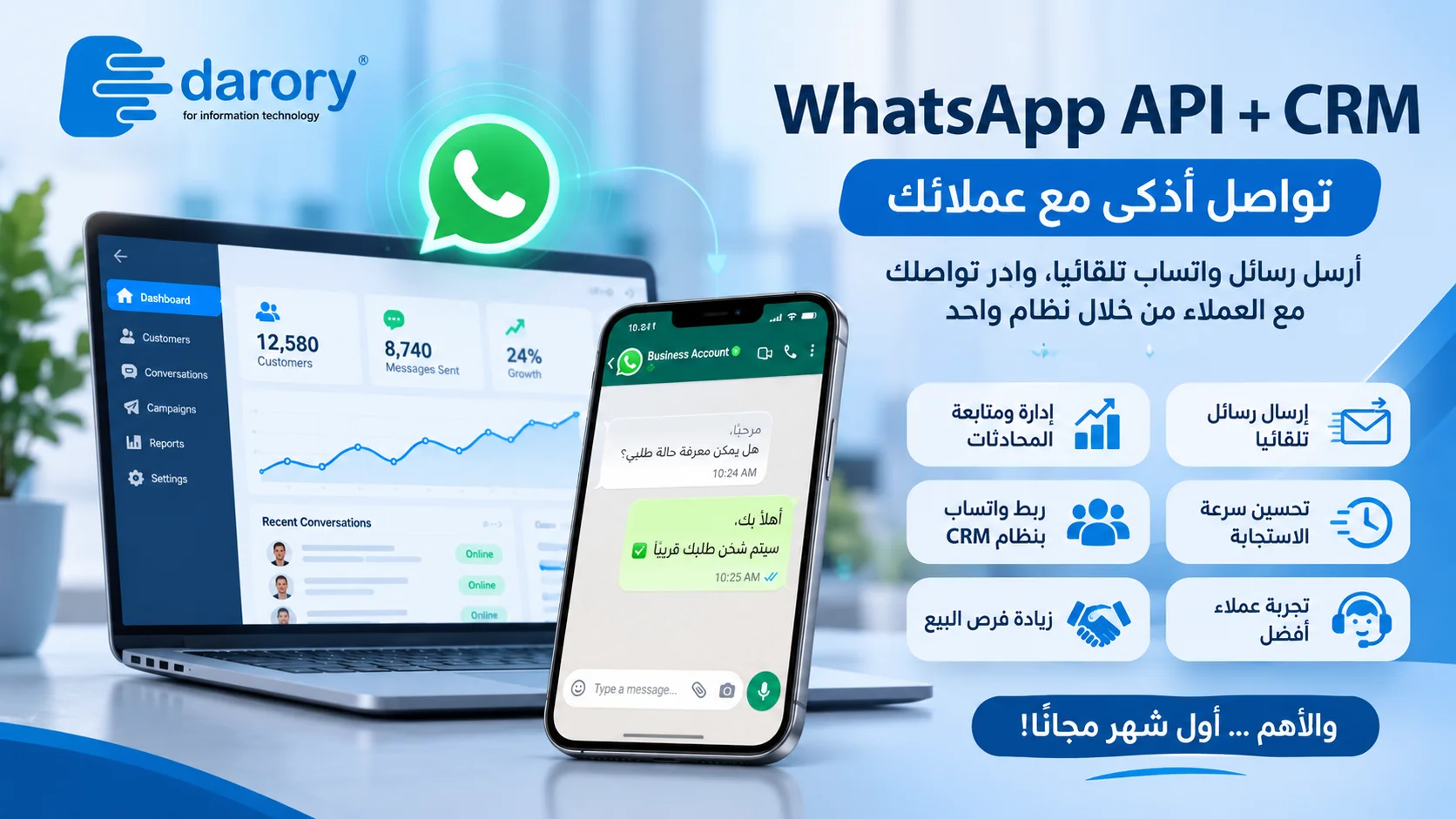
Through our dedicated WhatsApp API + CRM Gateway, we deliver seamless connectivity between WhatsApp and your operational systems—enabling automated transactional messages, webhook dispatching, and unified client communication hubs.
Whether you manage an e-commerce platform, field service operations, or an enterprise handling high inquiry volumes, investing in modern communication architecture is your most impactful step toward boosting productivity and expanding sales.
Transform Your Customer Communication Today
Explore the WhatsApp API + CRM platform from Darory, and take advantage of our current offer: Your First Month Completely Free!